

Decarbonisation
Nature Recovery, Climate Resilience

Keep off the Grass
Keep off the Grass: Low carbon, circular economy, verge management.
Introduction
Roadside verges have been managed in much the same way for almost 200 years: the grass grows, it is cut, and the cuttings are left to rot where they fall. This process is repeated many times each year, creating unnecessary carbon emissions while delivering little value for nature.
Keep off the Grass is developing a new approach to verge management that reduces carbon emissions, supports biodiversity, and turns green waste into a valuable resource.
As part of the Department for Transport’s Live Labs 2 programme, South Gloucestershire Council and partners trialled a lower-carbon approach across selected roadside verges. Instead of cutting grass ten times a year and leaving the cuttings behind, verges were cut less frequently and the grass collected and sent to Anaerobic Digestion (AD) facilities, where it was converted into:
- Biogas for electricity generation
- Biomethane for vehicle fuel
- Organic fertiliser for agriculture
The project demonstrated how highways, waste and environmental services can operate as a circular system — reducing emissions, supporting nature recovery, and creating environmental and social value.
Originally funded through the Department for Transport’s Live Labs 2 programme, the ‘Greenprint’ project was delivered in partnership with West Sussex County Council, the Future Highways Research Group, Plantlife, the University of the West of England, and the University of Nottingham.
The trial showed that substantial carbon and greenhouse gas (GHG) savings could be achieved through a new Cut and Collect (C+C) approach.
Operating over the next two years, across a smaller 12.8 hectare area, 'Keep off the Grass' is the next stage of this work. The project will now refine and scale the approach to create a practical, cost-effective model for wider implementation. This includes identifying the most suitable types of verges, improving operational efficiency, supporting better access to AD facilities, and increasing the benefits for biodiversity, soil health and climate resilience.
The aim now is to establish a new model for verge management and deliver carbon savings and environmental benefits at no additional cost.
The Cut and Leave Approach
The current high frequency “Cut and Leave” (C+L) approach is carbon intensive, resource heavy, and is of no value to nature.
Under this model:
- Verges are cut too frequently to allow many plants to flower and set seed.
- Grass cuttings are left to decompose on site, releasing carbon and greenhouse gases.
- Rotting cuttings increase soil nutrients, favouring a small number of vigorous grass species and reducing plant diversity.
- Short, species-poor grassland stores less carbon and supports fewer insects, pollinators and other wildlife.
- Frequent mowing creates repeated disturbance, noise and fuel use throughout the growing season.
Beyond keeping grass short, it delivers minimal environmental value.
The Cut and Collect Solution
The new Cut and Collect (C+C) approach provides a smarter, lower-carbon alternative:
- Cut later in the season to allow plants to flower and set seed.
- Cut less frequently to reduce disturbance, fuel use and emissions.
- Collect grass cuttings rather than leaving them to rot on site.
- Convert collected biomass into renewable energy and organic fertiliser through AD facilities.
The original trial took place across roadside verges in Yate, Bradley Stoke, Kingswood, Patchway, Staple Hill, Mangotsfield, Stoke Gifford and Thornbury.
A total of 37 hectares of verge were cut four times per year instead of ten. Grass cuttings were collected and transported to the nearest available AD facilities. Detailed comparison with a 26-hectare control area managed using the traditional C+L approach demonstrated significant carbon savings from the new model.
The trial also showed that further refinement could improve efficiency and reduce costs. A longer-term programme would help establish:
- Which types of verges are most suitable for C+C management
- The most effective machinery and operating methods
- The scale of biodiversity and ecological benefits over time
- The potential reduction in wildfire risk
- The long-term carbon storage benefits of more diverse grassland habitats
- Improvements in soil health and resilience
Keep off the Grass will help develop a practical and scalable operating model that reduces waste, emissions and maintenance impacts while supporting nature recovery.


-
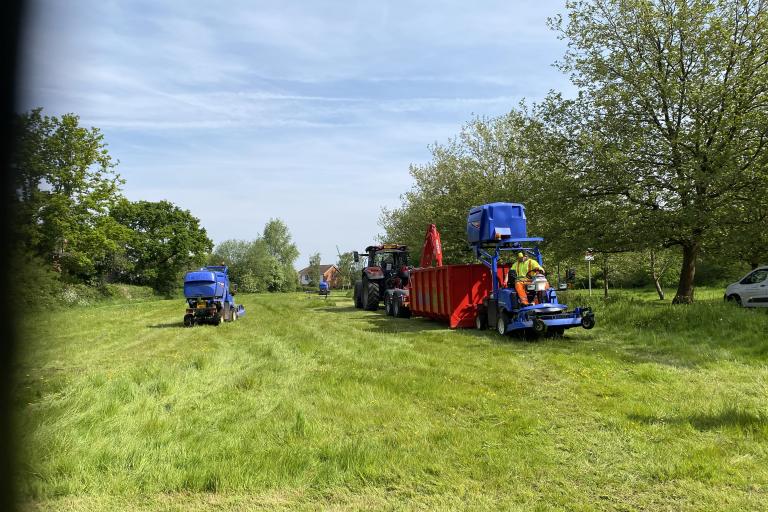
Using small machines is labour intensive. Collecting and off loading the cuttings slows the mowing process so that multiple machines and operatives are needed.
-
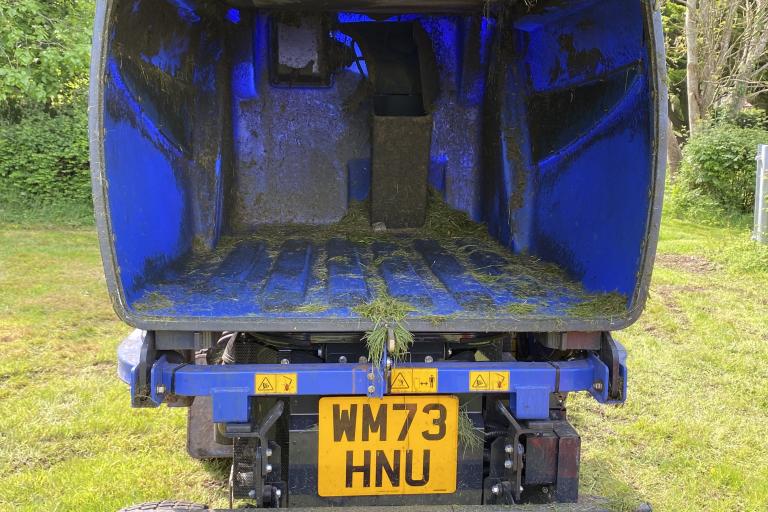
Clever and versatile, these small machines cut, collect and tip, but they're too small to be cost effective at the scale of operation needed.
-
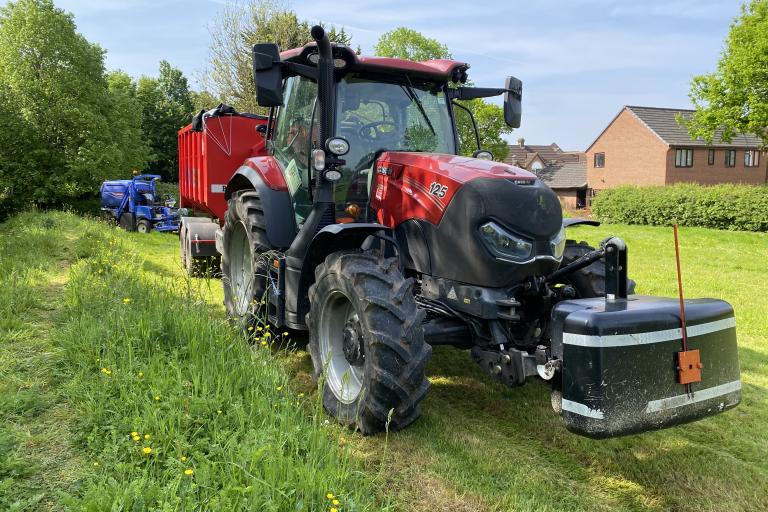
Delivery of the large trailer needed to transport the cuttings off site to the depot before being taken to the AD facility. A more local AD facility could enable cuttings to be delivered straight there, bypassing the need to drop at the depot first. Note the plant diversity already appearing in the area that's not yet been mown.
-
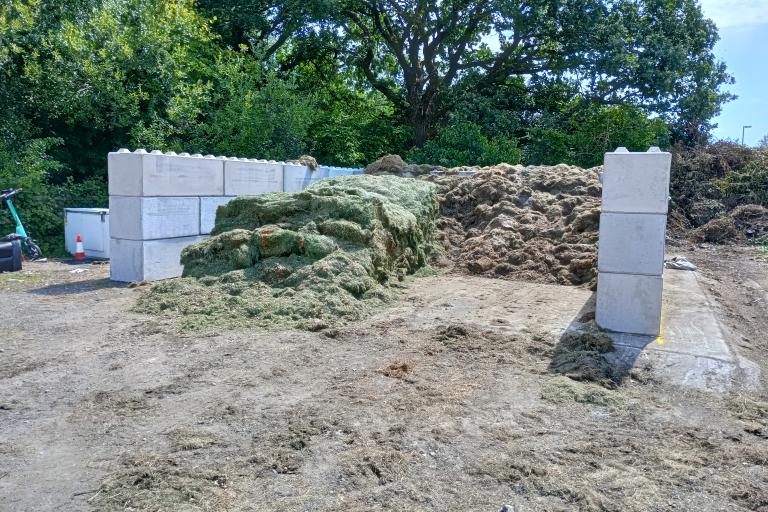
A small sample of cuttings, stored at the depot ready for transportation to the anaerobic digester (AD) facility. An AD facility located closer to the area, might enable some double handling of this biomass to be avoided.
-
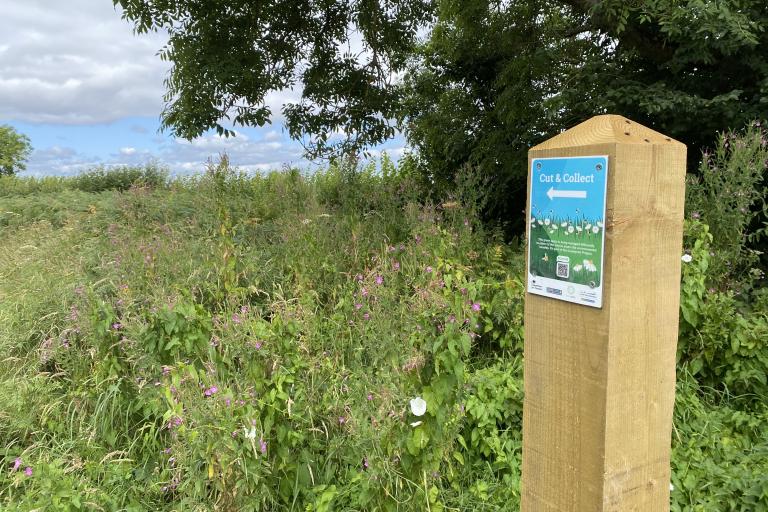
Keeping residents informed and engaged helped to ensure their support.
What Your Support Funds and How It Helps
The £21,000 fundraising total includes:
- 2 years of additional operational costs for 12.9 hectares - £9,362 per annum (Total £18,724)
- Administrative costs, fees, and contingencies circa 12% = £2,276
Your support will help bridge the gap between the traditional C+L model and a new lower-carbon C+C approach while operational efficiencies are developed over the next two years.
It can help achieve measurable environmental benefits immediately:
£81.63 supports C+C management of 1,000m² of verge for one year, avoiding 132.2kgCO2e emissions (£816 for one hectare, for one year, avoiding 1.32 tonnes CO2e).
£612 creates 1 tonne of carbon savings and enables 0.75 hectares of verge to be managed under the new C+C approach for one.
£1,000 supports C+C management of 1.22 hectares of verge for one year, delivering carbon savings of 1.62 tonnes CO2e.
Funding will help scale an innovative model with the potential to transform how roadside landscapes are managed for climate, nature and communities.
Summary of Benefits
Avoided Carbon and Greenhouse Gas Emissions
The trial demonstrated significant carbon savings from the C+C approach.
For every 1,000m² of verge managed under the new model, an estimated annual saving of 132.2kgCO2e is achieved - 1.32 tCO2e per hectare.
These savings come from:
- Preventing grass cuttings from decomposing on site
- Producing renewable energy from collected biomass
- Creating organic fertiliser to replace more carbon-intensive alternatives
The project also identified opportunities for further reductions through improved transport logistics and better access to local AD facilities.
Biodiversity
Although the original trial period was too short to measure long-term ecological change, existing evidence strongly suggests the C+C approach can significantly improve roadside biodiversity.
Potential benefits include:
- More flowering plants and greater seed production
- Increased plant diversity through reduced soil nutrient levels
- Better habitat for pollinators, insects and small mammals
- Improved soil structure and health over time
- Reduced nutrient run-off compared with synthetic fertiliser alternatives
Roadside verges represent one of the UK’s largest connected grassland habitats, offering major potential for nature recovery if managed differently.
Wildfire Risk
Leaving grass cuttings on verges can create dry, highly flammable material during hot weather.
The C+C approach reduces this risk by removing cut material and reducing fuel build-up along roadsides — common locations for fire ignition.
Longer grass also retains more moisture than repeatedly cut short grass, helping improve resilience during extended dry periods.
Amenity Benefits
Less frequent cutting allows roadside verges to become more dynamic, natural and visually interesting throughout the seasons.
Wildflowers and taller vegetation can improve the appearance of streets and public spaces while supporting birds, bees and other wildlife.
Importantly, the trial proved popular with local communities and generated very few complaints from residents.
Town and parish councils involved in the programme showed strong support for the approach and recognised its wider benefits for carbon reduction, biodiversity and local environmental quality.
Net Social Benefit
Adopting a cut-and-collect approach is successful in reducing carbon emissions and could deliver meaningful biodiversity uplift. If it were possible to trade the reduced carbon emissions and biodiversity uplift for their theoretical market value (estimated as £49/1,000M2/year for the carbon reduction and £77/1,000M2/year for the biodiversity uplift), these combined benefits would exceed the additional operational costs, providing a net benefit of £53.56 per 1,000M2 per year.
Reduced Waste and Circular Economy
The traditional C+L approach creates large amounts of low-value green waste that decomposes on site and releases greenhouse gases.
The C+C model transforms this material into a valuable resource, supporting a more circular local economy through the production of renewable energy and organic fertiliser.
This creates a practical example of how waste materials can be repurposed to deliver climate, environmental and economic benefits.
Building a Cost-Effective Delivery Model
The original trial demonstrated that the C+C approach delivers clear environmental benefits, but it also highlighted opportunities to improve operational efficiency and reduce costs.
For the 37-hectare trial area, the additional cost to manage verges under the new C+C approach was £72.78 per 1,000m² per year.
Keep off the Grass will focus on reducing this cost difference by refining how the service is delivered.
Key opportunities include:
- Selecting larger, more suitable verges that can be managed more efficiently
- Using more productive and durable machinery
- Reducing travel distances between verge sites and collection points
- Reducing labour requirements through improved operating methods
- Increasing the volume of biomass collected to strengthen the business case for more local AD facilities
- Exploring opportunities to use biomethane produced by the process as vehicle fuel for transportation
The aim is to create a financially sustainable model where carbon reduction, biodiversity enhancement and improved resilience can be delivered at no additional cost.
Until that point is reached, external funding is needed to support continued refinement, monitoring and expansion of the programme.
Why it Matters
The UK has lost an estimated 97% of its species-rich lowland grassland since the 1930s, while more than half of native flowering plant species have declined in range since 1970.
At the same time, roadside verges represent one of the UK’s largest remaining grassland networks. Studies suggest that around 70% of Great Britain’s 260,000 hectares of road verge is grassland habitat, much of it currently managed as frequently mown short grass.
Research consistently shows that reducing mowing frequency and removing cuttings can significantly increase plant diversity and improve habitat quality for wildlife.
Keep off the Grass presents an opportunity to turn roadside verges into healthier, more resilient spaces that support biodiversity recovery while also reducing carbon emissions.
This project responds directly to the growing challenge of climate change. Reducing greenhouse gas emissions, improving soil health, supporting pollinators, reducing wildfire risk and increasing ecosystem resilience are all essential parts of adapting to a changing climate.
By developing a practical, scalable and cost-effective new model for verge management, Keep off the Grass can help demonstrate how local action contributes to wider climate and nature recovery goals while creating cleaner, greener and more resilient communities.