
Blue Space Waterways Improvement
Nature Recovery, Climate Resilience

Three Brooks Local Nature Reserve eel pass: Phase one outflow
Coming soon a summary of the Eunomia natural capital valuation for this project.
Every year, one of nature’s greatest travellers arrives on our doorstep. The European eel begins life thousands of miles away in the Sargasso Sea near Bermuda, drifting on ocean currents for up to two years before reaching UK and European rivers as tiny, transparent “glass eels.” Over the following decades they grow, mature and, when ready to breed, make the astonishing journey all the way back across the Atlantic.
The problem
The European Eel, which is protected by UK law and recognised globally as “critically endangered”, is now in crisis. Since the 1980s, their numbers have fallen by around 95%. Having survived the perilous journey to reach our rivers and brooks, they meet dams and weirs that block their routes to vital habitat.
The aquatic habitats of Three Brooks LNR are centred around the Three Brooks Lake. The lake was formed by damming the confluence of the Stoke, Hortham, and Patchway Brooks, within a crater resulting from relief sewer construction. The Brooks flow through the reserve before reaching the lake, and their combined outflow forms Bradley Brook, which joins the River Frome about 3km to the south.
The lake's design and operation provide some controlled flood storage during wet seasons, reducing downstream flood risk without impeding natural flow. The design doesn’t allow for easy passage of fish and eels. There are three structures that control and manage the flow of the water in and out of the lake. Each of these creates a barrier preventing eel access to the the lake and the Stoke and Hortham Brooks:
- 2 x parallel concrete beam weirs where the Hortham Brook enters the lake.
- 2 x parallel concrete beam weirs where the Stoke Brook enters the lake.
- 3 x parallel concrete beam weirs where the lake outflows to the Bradley Brook.


-
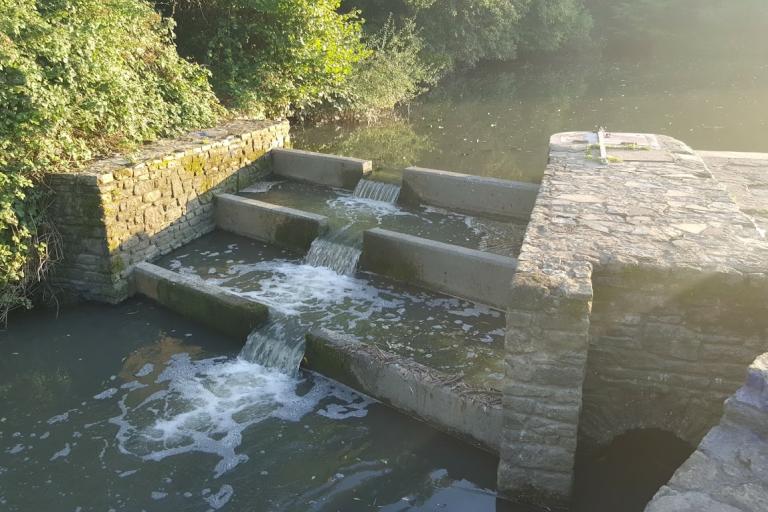
View of the three concrete beams and vertical stone walls that create the barrier at the outflow between the lake and Bradley Brook - where elvers are known to be found.
-
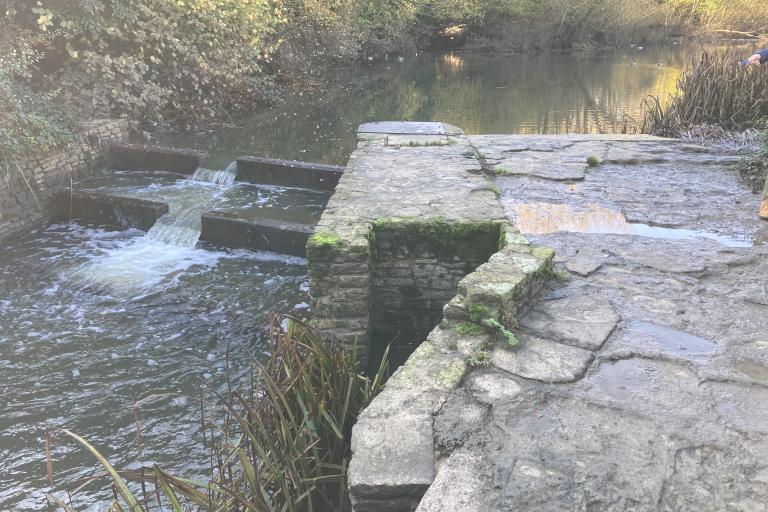
The concrete beams meet vertical stone walls to create an almost impenetrable barrier to the movement of fish and young eels. Beyond this point is a lake of over 7,000 square metres that would provide a variety of essential habitat opportunities for the eels and from there, access to the Stoke and Patchway Brooks.
-
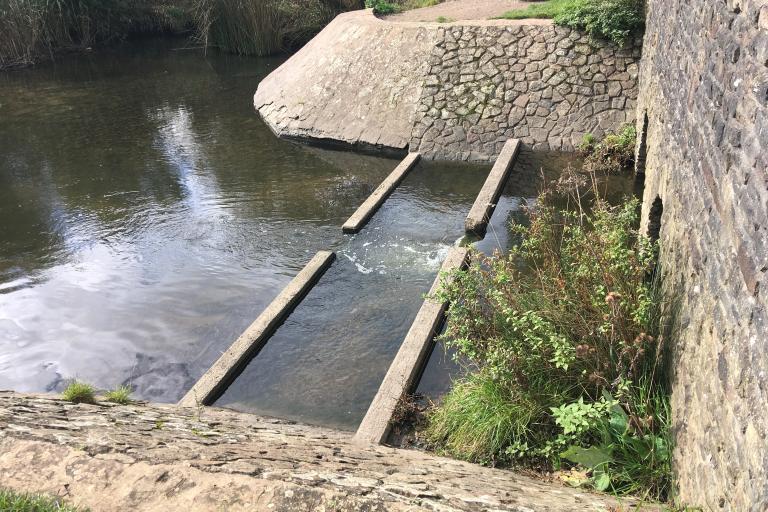
The concrete beam weirs that form the barrier to fish and eel passage where the Patchway Brook joins the lake. The stone embankment will allow the construction of a 'pebble' passage the eels can move along and climb over the beams.
-
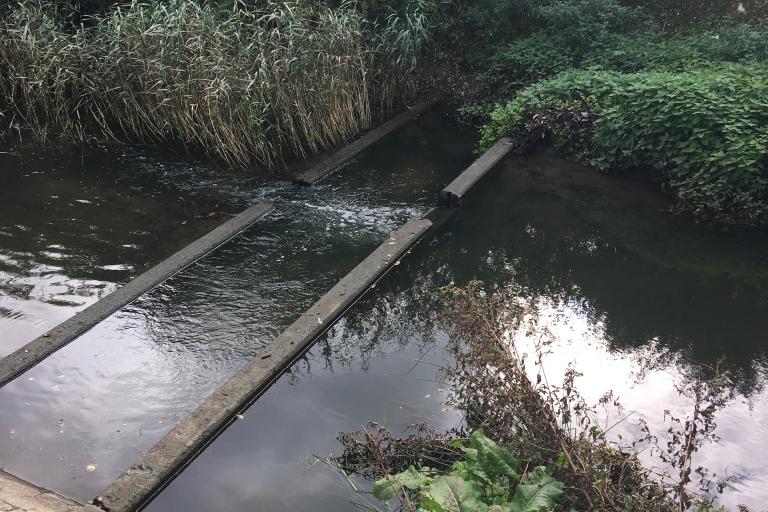
The two concrete barriers forming the weir that acts as a barrier to fish and eel passage at the inlet where the Stoke Brook joins the Lake. The shallow stone embankment will allow the use of a 'pebble' passage the eels can move along. Beyond this point is 13km of Brook, essential additional habitat.
Proposed solution
The structures around the lake play a vital job in keeping the area safe, controlling how much water flows in and out of the lake, reducing the risk of flooding downstream. Without them, heavy rain could cause the water to rise too quickly and overflow into nearby paths, homes, and natural areas. They still do this job exactly as they should. Removing them would be extremely expensive, creating more problems than it solves, for the lake and the whole drainage system that relies on it, so removing them isn’t an option.
This project will modify the different structures, retro-fitting features that will enable eels to overcome or bypass these obstacles.
South Gloucestershire Council, the Environment Agency, River Frome Reconnected partnership, and the Three Brooks Local Nature Reserve (LNR) volunteers are joining forces to take this action. The plan is to extend the habitat provided by the River Frome and Bradley Brook to ensure eels can access the Three Brooks Lake, then the Stoke Brook, and eventually, the Patchway Brook.
Phase 1 The outflow weir linking the lake with Bradley Brook
Overcoming this obstacle is the first phase as it denies access to the Three Brooks Lake. At 1.8 acres, or over 7,000M2 in size, the lake could provide substantial additional habitat for eel populations. The lake is also the gateway to the Stoke and the Hortham and Patchway Brooks.
Metal cassette cases containing specially designed eel tiles, will be attached along the length of the wall that runs along the ends of the concrete beams. The cassette case ends have openings allowing the eels to enter and leave. Once inside, the eel tiles provide the type of textured surface the young eels can move through, and along, climbing up and over each of the beams as they move through the length of the tiles.
Phase 2 The Stoke Brook inlet
When an eel population is established in the lake, the project can move to Phase 2, tackling the weirs where the Stoke Brook joins the lake. Overcoming this obstacle will open up 3km of additional habitat along the Stoke Brook.
Here, the two beams that form the weir meet a sloping stone embankment. A notch will be cut in this embankment and a layer of concrete laid over it, and pebbles set into the surface of the new concrete. These pebbles provide the young eels with the kind of textured surface that will allow them to move over the beams and then enter the Stoke Brook.
Phase 3 The Patchway and Hotham Brook inlet
The same ‘pebble’ passage solution can be used here to overcome this obstacle. This work will create access to an additional 0.3km of brook where another fish barrier exists. A separate project is looking at long term solutions to address this to open up the whole of the Horthan/Patchway brook.
Why it matters
The Bristol Frome has a mixed fish species composition with coarse fish species and European eels predominant in the lower and mid reaches. The European Eel population has dropped dramatically since the 1980s and is now classified as ‘critically endangered’ by the IUCN red list of threatened species, it is now so vulnerable, that any and every measure to support its recovery, is of high value.
The available evidence shows that eels can migrate into the Bristol Frome and reach the Bradley Brook. Elvers are known to be present. Improving fish passage is therefore important work, providing essential changes needed to support eel recovery.
The uniquely fascinating European Eel has an extraordinary life cycle, which includes one of the most astonishing animal migrations observed in nature. Sadly, the number arriving in Europe has fallen by around 95% in the last 40 years.
Support us in giving this remarkable creature a future. Together, one passage at a time, we can strengthen the connection between the European Eel, the River Frome and the Three Brooks.